
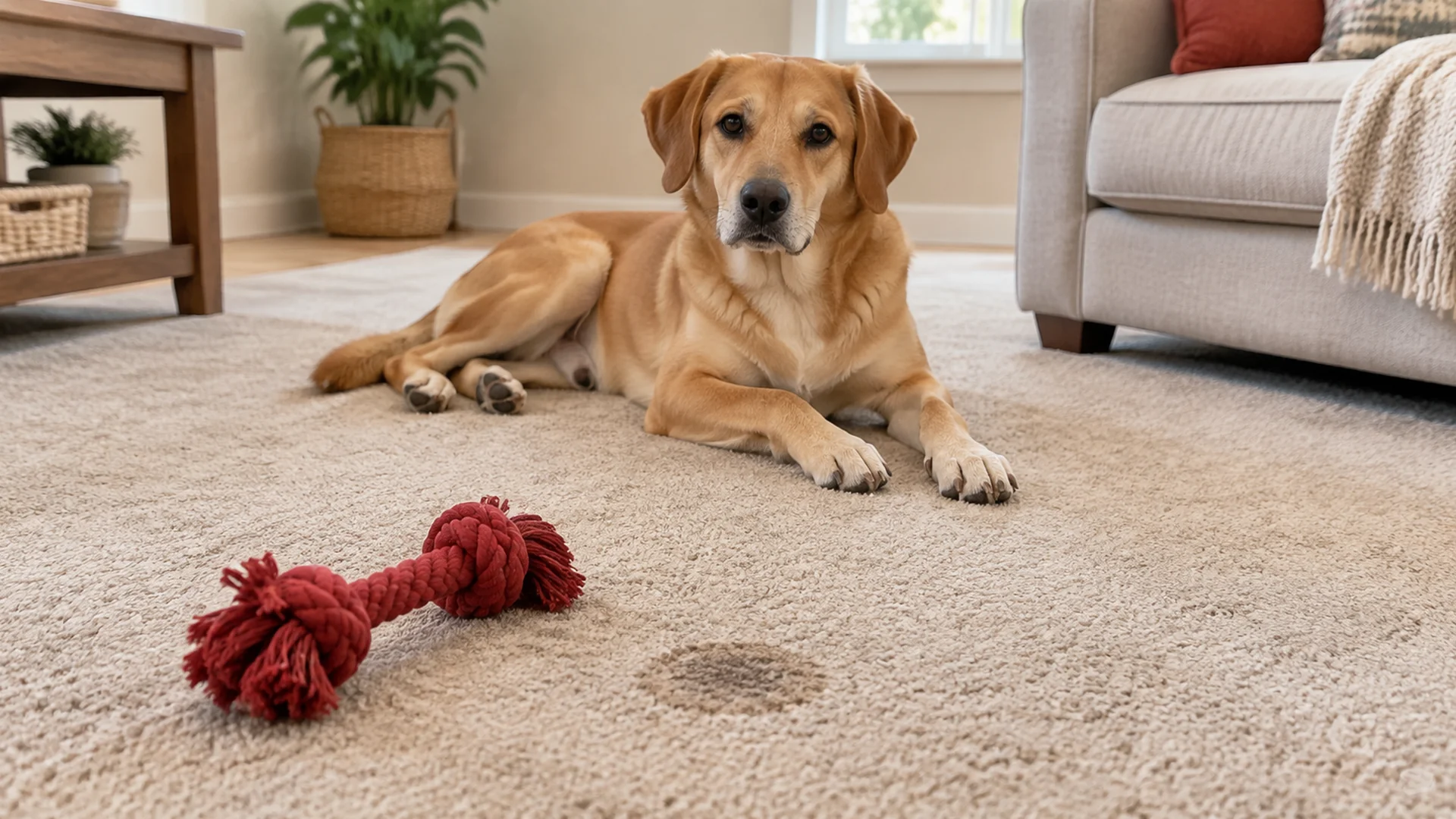
Pet urine on carpet needs a response suited to the fresh liquid, any older stains and the carpet itself. Blot a fresh accident before it spreads, then follow compatible carpet-care and product instructions. For a dry mark or recurring odor, review the history before adding more liquid.
A fitted carpet, a wool rug and an upholstered cushion do not automatically take the same treatment. Keep the material and the earlier products central to the decision. A stronger fragrance can cover a smell without resolving the affected spot.
Blot a Fresh Accident
Use clean white absorbent cloths to remove fresh liquid. Press and lift rather than rubbing it into the surrounding pile. Switch to a clean area of cloth as it absorbs liquid and keep pets away from the spot.
Do not use an ordinary dry vacuum on a liquid spill or pour water over the carpet to flush it yourself. More moisture is not a reliable way to reach an unknown problem beneath the surface.
If the material is unfamiliar or a valuable rug is involved, pause before applying a product. Check the manufacturer's instructions or ask for material-specific advice.
Record the Spot and Earlier Treatments
Note where accidents occurred, whether the same place has been affected repeatedly and how long you have noticed a mark or odor. Keep the name or container details of any vinegar, powder, detergent, pet cleaner or machine treatment already used.
A visible stain does not show how far liquid traveled into the backing or padding. A color change is not proof that the source was urine, either. If you do not know what caused a mark, say so.
For cat urine, a black light is not a complete assessment of the carpet or underlying layers. Use observations to describe the concern rather than treating a bright patch as the full extent of the problem.
Choose a Carpet-Compatible Treatment
Find the care instructions and consider the fiber, dye and backing before selecting a cleaner. A labeled enzymatic pet product may be an option where its label and the carpet guidance permit it. The word “pet” on a bottle does not establish suitability for every surface.
Test in a hidden area and check for color transfer or a texture change. Follow the product's stated amount, application, dwell time and drying requirements. Do not substitute a universal soaking time or a larger dose.
The Humane Society's pet-stain advice discusses odor neutralizers, testing and the limits of surface cleaning when urine reaches padding. It cautions against steam cleaning urine odors. Use the procedure suitable for your material instead of alternating heat, vinegar and detergent.
Do not mix products or layer bleach, disinfectant, fragrance and another cleaner over the same spot. Keep pets away until the label's return-to-use conditions are met.
Treat Old Urine Stains as an Assessment Problem
An established mark may be dry while an odor remains. Consider its age, repeated accidents and earlier treatments before wetting it again. A surface spot and an affected backing or padding need different assessment.
Where a permitted procedure calls for blotting or residue removal, follow those directions with controlled amounts. Do not automatically add powder as a finishing step or flood the area with rinse water.
Let the carpet dry before judging a remaining mark. Our carpet-drying guide explains aftercare questions for ordinary cleaning, including airflow and when to return the area to use. It does not replace the product's instructions or an assessment of an unresolved moisture problem.
Stop repeated treatment when an odor persists, a mark returns or the carpet changes color or texture. More liquid can complicate a problem whose depth and source are still unknown.
Know What Surface Cleaning Cannot Promise
Cleaning cannot restore every dye change, repair damaged backing or guarantee permanent removal of odor from every affected layer. Ask what can be treated, what remains uncertain and whether a flooring professional needs to assess underlying material.
Do not lift fitted carpet yourself to investigate. Explain known moisture beneath the surface or damage before arranging ordinary cleaning so the estimate does not assume a simple spot.
For a separate rug or fabric item, identify it specifically. Fitted-carpet room pricing and handling do not automatically cover it.
If Cat Accidents Keep Happening
For a cat whose toileting behavior has changed or whose accidents continue, arrange veterinary advice. Cleaning the spot and understanding the animal's needs are separate tasks. A cleaner cannot diagnose a pet or decide why it avoids a litter box.
Keep a record of when and where accidents happen so you can give the veterinarian useful information. Avoid treating a cleaning product as the whole answer or assuming the behavior is deliberate.
For another pet, describe its accident history when discussing the cleaning. Do not apply cat-specific behavior advice to every animal.
Discuss the Stain and Odor Together
Our pet stain and odor treatment page explains what we need for an estimate. Share the surface, approximate area, whether accidents are fresh, old or recurring, and the products already used.
We can discuss suitability and realistic work without promising that every old mark or underlying odor can be permanently removed. You do not need to diagnose the fiber or lift the carpet before making an inquiry.